
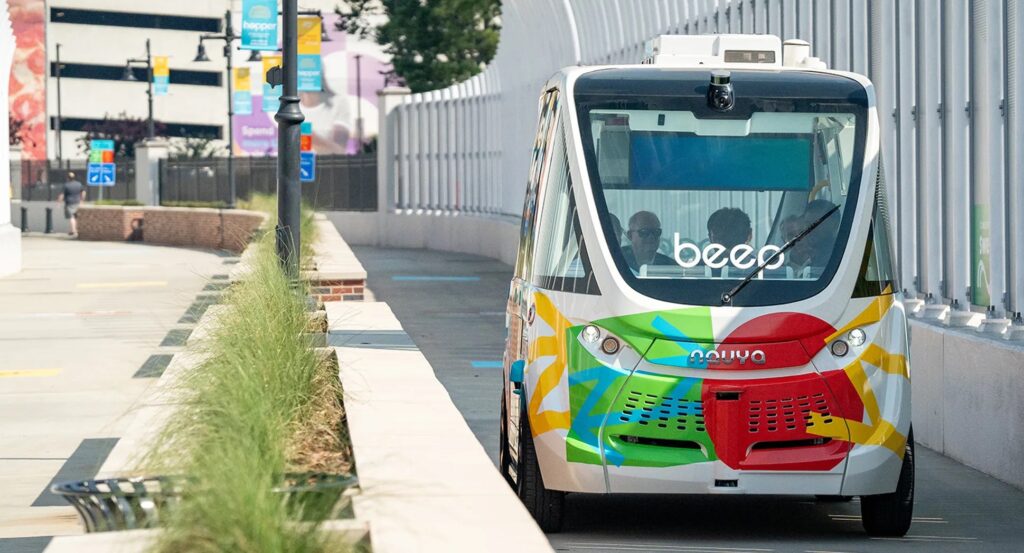
We may not have the flying cars we were promised, but Cobb County is about to see something just as disruptive: driverless public shuttles operating in the same traffic as human drivers. Backed by a $6.6 million Federal Transit Administration grant, the Cumberland Autonomous Mobility (CAM) Network plans to launch autonomous electric shuttles in 2027. Whether the rollout stays on schedule is uncertain—public-transit projects rarely do—but the change is coming.
These shuttles won’t be isolated or separated from regular traffic. They’ll be at the same intersections, in the same turn lanes, and in the same rush-hour congestion as everyday motorists. That alone makes this one of the most significant transportation shifts in Metro Atlanta.
And with driverless vehicles sharing the road for the first time in Cobb County, some residents will undoubtedly find themselves facing complicated liability questions if one of these shuttles causes a crash.
Where the Shuttles Will Run
The CAM Network will connect some of Cumberland’s highest-traffic destinations, including:
- Truist Park & The Battery Atlanta
- Cobb Galleria Centre / Cobb Convention Center
- Cobb Energy Performing Arts Centre
- Cumberland Mall
- Chattahoochee River National Recreation Area
This route expands on the Cumberland Hopper pilot and is part of the broader Cumberland Sweep plan—a long-term strategy to reshape mobility across the district. For the first time, autonomous public-transit vehicles will be sharing lanes with Georgia drivers.
How the Technology Works
The shuttles will operate without a driver, relying on a combination of cameras, radar, lidar, GPS, and onboard computing that makes real-time driving decisions. But “driverless” doesn’t mean “unmonitored.” Each shuttle is supervised remotely through constant camera feeds, sensor data, and telemetry streamed back to a control center.
That setup raises practical oversight questions:
- How many vehicles is a single remote operator responsible for at once?
- What does their training look like?
- How long are they on shift?
- When are they required to intervene, and what triggers that intervention?
- How quickly must they override the vehicle’s behavior if it reacts poorly?
There’s also the issue of in-shuttle passenger safety. With no onboard attendant, interior monitoring matters. If someone stands while the vehicle is moving, interferes with equipment, or suffers a fall after sudden braking, what happens next? Who reviews the footage? What policies govern response? These details affect safety just as much as the sensors on the outside.
Human error will continue to exist on the road—and so will software error. One comes from people; the other comes from the technology. Both are unavoidable. When the two interact in real traffic, incidents will happen.
Who Is Driverless Shuttle Company Beep, Inc.?
Cobb County selected Beep, Inc.—a privately held autonomous-mobility company backed by venture-capital and growth-equity investors—to operate the CAM Network. Beep runs autonomous shuttle programs across several U.S. cities and uses its AutonomOS™ system to manage real-time oversight of each vehicle.
Although the shuttles are self-driving, Beep essentially functions as the operator—just from a remote control center instead of the driver’s seat. Its responsibilities include:
• monitoring live video feeds
• tracking shuttle location and speed
• reviewing sensor and braking data
• intervening when the shuttle behaves unexpectedly
Beep’s decisions, staffing, training, and intervention standards will play a critical role in how safely these vehicles operate in Cobb County. It is not hard to imagine a company cutting corners by short-staffing remote operators, overworking them, or skimping on training—and Beep will need to avoid those predictable pitfalls if these shuttles are going to operate safely in Cobb County.
Who is Responsible When a Driverless Shuttle Fails?
If an autonomous shuttle fails to act the way a reasonable driver would act—whether because a remote operator didn’t intervene, wasn’t paying adequate attention, or If an autonomous shuttle fails to act the way a reasonable driver would act—whether because a remote operator didn’t intervene, wasn’t paying adequate attention, or was responsible for too many vehicles at once—that is a claim sounding in negligence. By contrast, when the failure stems from the vehicle itself—its software, sensors, braking logic, mapping data, or detection systems—those issues fall under strict liability and product liability, because the product placed on the roadway was defective.